News
Screen Innovations HQ Tour Reveals Projection Screen Product Line Depth
Review by Todd Anthony Puma for Residential Systems Magazine, December 2012.
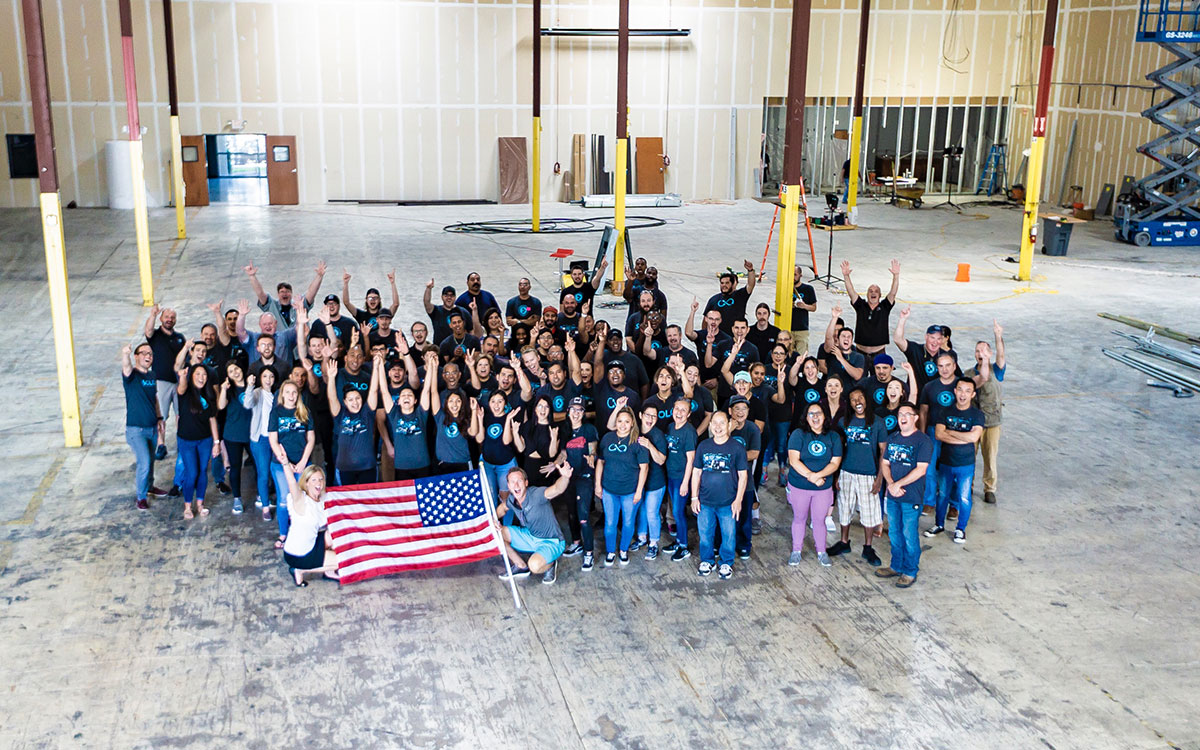
I was recently given the opportunity to take a trip down to Austin, Texas to visit the Screen Innovations facility and see all the new projection screens they have developed. Originally, the purpose of the trip was to write a review on the Black Diamond Zero Edge and Black Diamond Motorized screens only, but once I got there, I found that there was so much more to Screen Innovations than meets the eye that I felt compelled to share their entire story.
Ryan Gustafson, SI’s president and chief innovator, actually began building screens in his garage in the late hours of the night after working all day as a retail sales associate at Austin’s own A&B TV in 2004. This inspiration came after he purchased his first LCD projector, the Sony VPLVW10HT. In his efforts to maximize its abilities, he began building screens and testing them with the projector in order to achieve top quality results. His screen designs became so advanced that A&B actually picked up Ryan’s screens to sell in their store. Within a short time, Ryan branched out and opened a facility of his own facility in Austin, Texas, where he was able to expand and grow his business by roughly 40 percent every year since.
Factory Tour
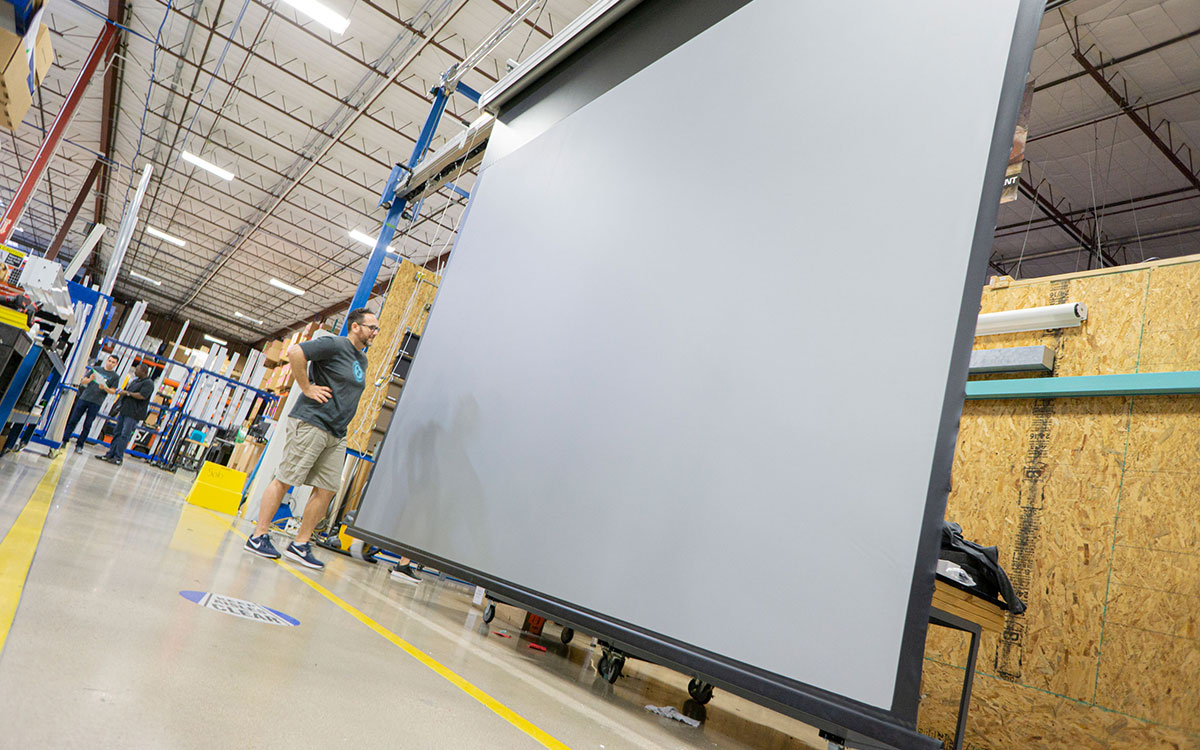
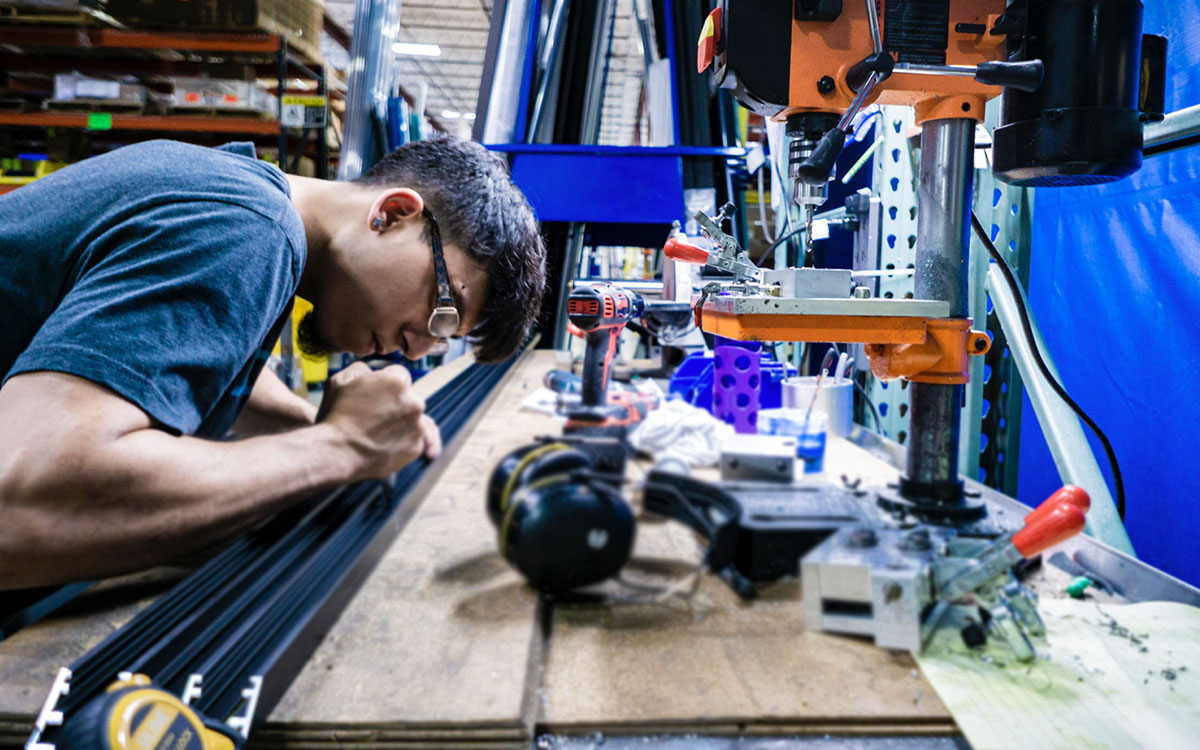
As the grandson of an inventor, Gustafson is a naturally inventive person. He not only fashioned many of the projection screens himself, but he is also the brains behind much of the equipment that is used in manufacturing Screen Innovations products, many of which I’m told are unique to SI.
For instance, Gustafson and his team claim to be one of the few in the industry that design their own extrusions. In fact, they have developed the only 3.5-inch aluminum tube extrusion that has less than 1/16 inches of deflection over 16 feet, as well as the only 4-inch aluminum tube extrusion that has less than 1/16 inches of deflection over 22 feet. These capabilities not only allow for more versatility in the size of a screen, but also result in less weight and bulk, which lowers freight costs.
![]() |
| Blake Vackar (left), director of sales for Screen Innovations, with Todd Anthony Puma. |
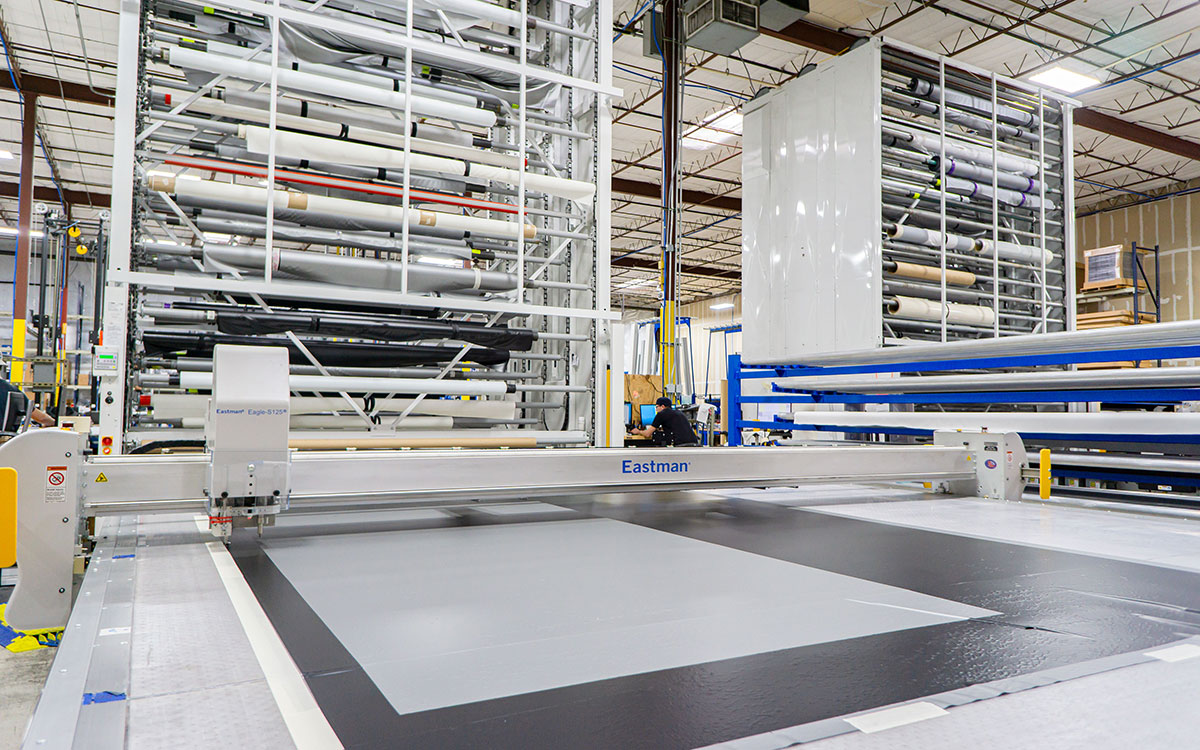
I was also shown how Screen Innovations uses movable snaps rather than screws to secure their screens in place, which is interesting because it allows SI projection screens to be uniquely interchangeable for those times when customer wants to upgrade the material on the screen. Only new material is needed, the frame remains. They also showed me how they utilize the very first automated snap machine to efficiently support this method. It was impressive to see they had built a 20×30-foot CNC robot that can be programmed to cut a screen to any size or shape that’s needed, which I can see being a benefit to the commercial market especially.
“We use the latest FEA [finite element analysis] software and spend countless hours of development time perfecting shapes that break the mold of what is possible in projection screens,” Gustafson stated.
Ryan’s brain is constantly churning out new ways to perfect their screens and advance the two-piece projection category. He even shared with me an awesome story that illustrates his ingenuity and explains how he came up with a solution to secure the Black Diamond Motorized projection screen to its housing. As the story goes, they spent three and a half years developing Black Diamond Motorized, and in particular, ways to get the screen to lay flat. The answer dawned on him one night while he was struggling to get rubber bands out of his daughter Taylor’s hair.
“We needed to solve a problem we were having with deflection when we were mounting the screen to the wing,” Gustafson explained. “You see, the wing has natural deflection, which was allowing the screen to get tight in the middle and soft at the edges. We tried more than 50 solutions, but they allowed the edges to get tight while the middle was soft; there was seemingly no way around the issue. One night, as I tried to extract a tangled band from Taylor’s hair, I had an inspiration. The next day, I brought a handful of her hair bands to the factory and went to into the lab. We laid out the screen, punched holes along the top of it and put the hair bands through the holes. The hair bands equalized the screen tension perfectly, which eliminated the need for 92-, 100-, 106-, 110-, 120-, or 133-inch screens to each require a unique wing that would counteract deflection.”
![]() |
| When the Black Diamond Motorized screen suffered from deflection issues when mounting the screen, Gustafson solved the issue with his daughter’s hair bands. Purpose-made bungees are now used. |
With Taylor’s hair bands in place, the edges and middle of the screen were both tight, which solved the problem. Now, instead of Taylor’s hair bands, SI uses ethylene propylene diene monomer (EPDM) bungees that are made for this purpose.
Projection Screen Reviews
All of the Screen Innovations fixed projection screens use microfiber frames as opposed to velvet, because microfiber attracts less dust and is easier to maintain. Black Diamond screens are unique in that they feature a laminate screen that is water resistant and fingerprint proof, which allows dust and other contaminants to wipe right off. This is important to note, as other screens with sprayed-surfaces lose portions of their optical finish when they are touched or cleaned, which ultimately deteriorates the picture quality. In my experience, customers are always afraid to touch their screens, even if they know they can. From an integrators perspective, this provides a great opportunity to get back into a client’s home to clean their screens, while using the opportunity to update, upgrade, and upsell new technologies to a captive audience who already trusts you to provide the very best solutions for their particular situation. As integrators, we must always be selling or we’ll march ourselves into extinction.
As I reviewed the line, I wanted to keep as many constants as I could to get an accurate comparison between the screens. I used a non-calibrated Epson Powerlite Cinema 6010 projector, stationed 12 feet from the screen and in the “cinema” setting for each screen I reviewed. I also used the same scenes from Disney Pixar’s Wall-E and The Amazing Spiderman as my demo movies for each of the screens I reviewed.
Lunar 4K 0.85-Gain Projection Screen
The Lunar 4K 0.85-gain grey screen was developed to create deeper blacks and to work in an environment where there would be soft ambient light. I viewed it in complete darkness and also flanked by two 75-watt floor lamps. One of the most common misconceptions about the Lunar Grey screen is that it does not improve contrast, but instead improves the black levels at the expense of the white levels, for which our eyes will compensate. The black levels were deep and created a great contrast with most of the other colors. On the contrary, I noticed that there was noise around the white images, mostly around wording. While viewing Wall-E, one of the first scenes has a large blue screen with white writing and there was almost a haze around the wording, which distracted my eye. I, personally, would not choose this screen option for my clients.
Gamma Maestro Acoustically Transparent Projection Screen
The Gamma Maestro is an acoustically transparent woven screen material that does not absorb ambient light the way a gray screen would. It is at its best in a darker environment, although it will still perform in very minimal light. It has a very warm, neutral and inviting hue that it adds to the image. While all of the color is rich and defined, I found that reds, grays, and blues were particularly heightened. The noise around white images were not present in this screen, the wording from the same scene in Wall-E was crisp and clear.
| A demo from The Amazing Spiderman on SI’s Solar 4K 1.3 Gain screen. |
Black Diamond Zero Edge 1.4 Gain Projection Screen
Prior to Black Diamond, two-piece projection was primarily used in dark environments, not because we wanted to, but because we had to. Now with Black Diamond, a screen can look just as good in ambient light as it does in a dark room. Unlike high-gain screens, however, Black Diamond rejects ambient light; therefore, the onscreen image is not diluted.
The technology behind Black Diamond allows it to reject ambient light coming from both the vertical and horizontal plane. The only time this doesn’t work is when a light source is coming from behind the projector. For example, if you have a west-facing window located directly behind the projector at 5:00 p.m., you’d probably want to cover that window, just as you would with any other display.
![]() |
| A demo at the Republic Gastropub bar illustrating the difference between matte white and a Black Diamond screen. |
Black Diamond Motorized Projection Screen
The Future of SI
Screen Innovations has been consistently experiencing 40 percent growth each year in domestic and international sales. They have already become the “it” screen in the residential scene and are just beginning their passage into the commercial world. Their screens were featured in many of the leading projector manufacturer’s booths at CEDIA and Infocomm in 2012—Epson, Sony, DPI, Wolf, Panasonic, JVC, Optoma, and Sim2 all used Screen Innovations in their booths, and BenQ even had a mind-blowing circular 65’ Black Diamond screen that they used as their overhead sign that SI created for their exhibit.
After two years of R&D, the team at Screen Innovations just launched a new commercial technology called FlexGlass. FlexGlass is a new rear projection screen material that offers all of the benefits of rigid optical glass and acrylic panels with the added benefit of custom and curve capabilities that can only be achieved with flexible screen materials. FlexGlass eliminates projector hot-spotting 100 percent, and from what I saw, has zero sparkle. It seems this would be an ideal choice for multiple-projector, edge blending, and short throw projector applications that are often needed in commercial, digital signage and some higher-end residential settings. One other note FlexGlass is 20 times lighter than Glass and ships on a roll, and costs much less to ship than other solutions.
AudioHolics Screen Innovations Black Diamond Zero Edge G2 Preview
We reported on the first generation of Black Diamond Zero Edge a while back. Since then, Screen Innovations has been working hard to improve their initial offering. We’d say they’ve done it. First, the video:
The claim to fame for the Black Diamond Zero Edge product is the very small bezel. Screen Innovations has improved that frame with an optional LED lighting kit which will project up to 256,000 different colors on the wall behind. This projection screen has the ability to enhance the projector’s contrast by over 900% while rejecting ambient light! This makes the Black Diamond Zero Edge G2 the perfect solution for any room where absolute light control is not an option. It also makes it look like a really, really big TV.
Currently, the Black Diamond Zero Edge G2 starts at $3099 and is available in either Black .8 gain, Black 1.4 gain, or Silver 2.7 gain screen materials. Screen Innovations has also improved the frame for better structural support and improved the shipping cartons to reduce shipping costs by more than 65% on average. That’s a pretty big deal, particularly for custom installers who are bidding these screens.
Conclusion
Is the Screen Innovations Black Diamond Zero Edge G2 projection screen cheap? At a base price of $3099, many would say “No”. But comparing to the price of a flat panel of the same size, Screen Innovations says that their screen is actual cheaper per inch. We’re not sure if that includes the projector but we’re willing to bet it’s true. The problem with front projection systems has traditionally been ambient light. With the Black Diamond Zero Edge G2 screen’s ability to enhance the projector’s contrast by over 900% while rejecting ambient light, this may be a thing of the past. With the look and feel of a flat panel TV, the Black Diamond Zero Edge G2 screen will leave your friends wondering how you got such a huge TV without mortgaging your home.
Cedia Electronic Lifestlyes — Fall 2012
Florida Modern
Krissy Rushing
A contemporary escape has all the comforts you’d expect when on vacation, including an easy-to-use automation system and totally hidden technology.
What better way to spend vacation than in Florida, with the wind rustling through the palm trees, gorgeous canal views, and stunning modern interior design, plus all the high-tech amenities that make life more fun and convenient? This new-construction project took all aspects of the owner’s vacationing comfort into account, including a complete whole-house automation system. The owner wanted systems that anyone in his family could operate on site and remotely. So electronic systems integrator First Priority Audio provided him with up-to-the minute technology that didn’t require extensive maintenance.
First Priority Audio accomplished this by using multiple applications available from the various component manufacturers, tied together via Vantage Controls’ powerful Design Center software and Automation Connection’s HomeControl Plus app, which allowed the company to put all the functionality you’d find on a touch panel directly onto the homeowner’s iPads. From this familiar interface, anyone can access and control the Sonos music systems, the security system via the NUUO iViewer, lighting, climate, shades, pool and more. Even the custom motorized TV cabinets are operable from the iPads.
The gorgeous cabinets, found both in the Master bedroom and the family room, were sourced by interior designer Ken Crawford and feature Nexus21 mechanisms inside that lift the Samsung HDTVs out of their hiding spots when desired.
According to Bert Herrero, owner of First Priority Audio, distributing HDTV to all the various Tvs in the home was the project’s biggest tech challenge. “We used a few different products to get the HDMI video to distribute seamlessly. We finally chose SnapAV’s Binary HD2-CAT-1080p-130 to get highdef to all 10 televisions. It performed up to par and delivered the signal reliably.”
To make the audio experience as stealthy and enjoyable as the video system, First Priority Audio used TruAudio Ghost Series GG-8 in-ceiling speakers throughout the home, allowing residents to listen to their music collection, Pandora or Rhapsody from any location.
While most of the home’s technology is hidden in walls and pop-up TV cabinets, in the den, a mini home theater hides nothing, including ambient light. Here, the residents’ desire for a bright, open area was very important. So instead of concentrating on window treatments, First Priority Audio made the image as bright as possible. The team used a Screen Innovations Black Diamond Zero Edge Film Screen that reflects ambient light, while accepting direct light from the super-bright BenQ SH960 projector.
The Vantage Controls system alters the projector’s operation by taking input from a light-reading sensor and dropping usage from 5,500 lumens using two lamps during the day to 2,500 lumens using one bulb at night when ambient light is not as competitive. In addition to the TruAudio speakers, two in-wall Velodyne subwoofers provide plenty of low-frequency energy.
So whether this lucky homeowner is enjoying a flick, whole-house music, checking his security feeds from his iPhone, or just taking in the views of the Sunshine State, he has every possible high-tech convenience at his fingertips.
Top Tips for Working with an Interior Designer, From Bert Herrero
Understand the design and how integrators can deliver custom integration products to keep up with their design.
Be open-minded to the designer’s plan.
As an integrator, we should be up-to-date to meet the design plan.
Keep the interior designer involved in the process whether they want to be or not.
Not all designers are created equal. We were lucky to have Ken Crawford on the project, who was a pleasure to work with.
As integrators, we need to be able to sell the “wow” factor to the designer so they can create an atmosphere to encompass the entire project.
Teach the interior designer the functionality of the system. Bringing them into your world builds a relationship that can lead to future business.
(read more)
Home Toys This is not your grandfather’s TV
TV, as we have historically known it, has been delivered to us in the form of LCD, LED and Plasma TVs which have historically ruled the residential entertainment environment. Two-piece projection, on the other hand, has typically been thought of – and used for – dedicated home theater rooms, commercial jobs, and other high-end installations. Fortunately, times have changed, technologies have advanced, and two-piece projection is now a mainstream solution. Prices have come down and manufacturers are making projectors, screens and accessories that function extremely well anywhere in the home, even in rooms with a lot of windows or ambient light. In fact, the category is much more approachable from a price, feature, and ease of installation standpoint. Meaning, there is now a two-piece projection solution for nearly any type of application or installation; residential or commercial.
Residential entertainment design has moved away from dedicated, dark, and often detached home theater rooms and has evolved into open concept “home cinema” entertainment spaces that exist within the primary living area.
The reality is that a cultural shift is occurring, and with it, the way families interact and entertain at home has dramatically changed. The family unit has become stronger and more connected in many ways, and much of that is due to interactive, multi-player gaming technologies like Xbox Kinect and Nintendo Wii, 3D video content, and larger display technologies that deliver a fully immersive, next-level cinematic entertainment experience that families can enjoy together. Ambient light rejecting screen technologies, like those that SI innovated and uses to great success, have enabled two-piece projection systems to emerge from dark home theaters into light, airy, and open rooms.

Two-piece projection in any room or any environment, really?
Absolutely. Two-piece projection systems can now easily replace TVs in almost any room of the house; great rooms; living rooms; bedrooms; open-concept entertainment spaces; or almost anywhere else a TV is desired. This is where the category gets really interesting, and why you should take note. No longer must the TV be a big, bulky, and ugly component hanging on the wall, reflecting light and competing with existing design and décor elements. By using two-piece projection systems, TV can actually be an integrated design element that is as much desired as it is appreciated.
You can’t put a TV there
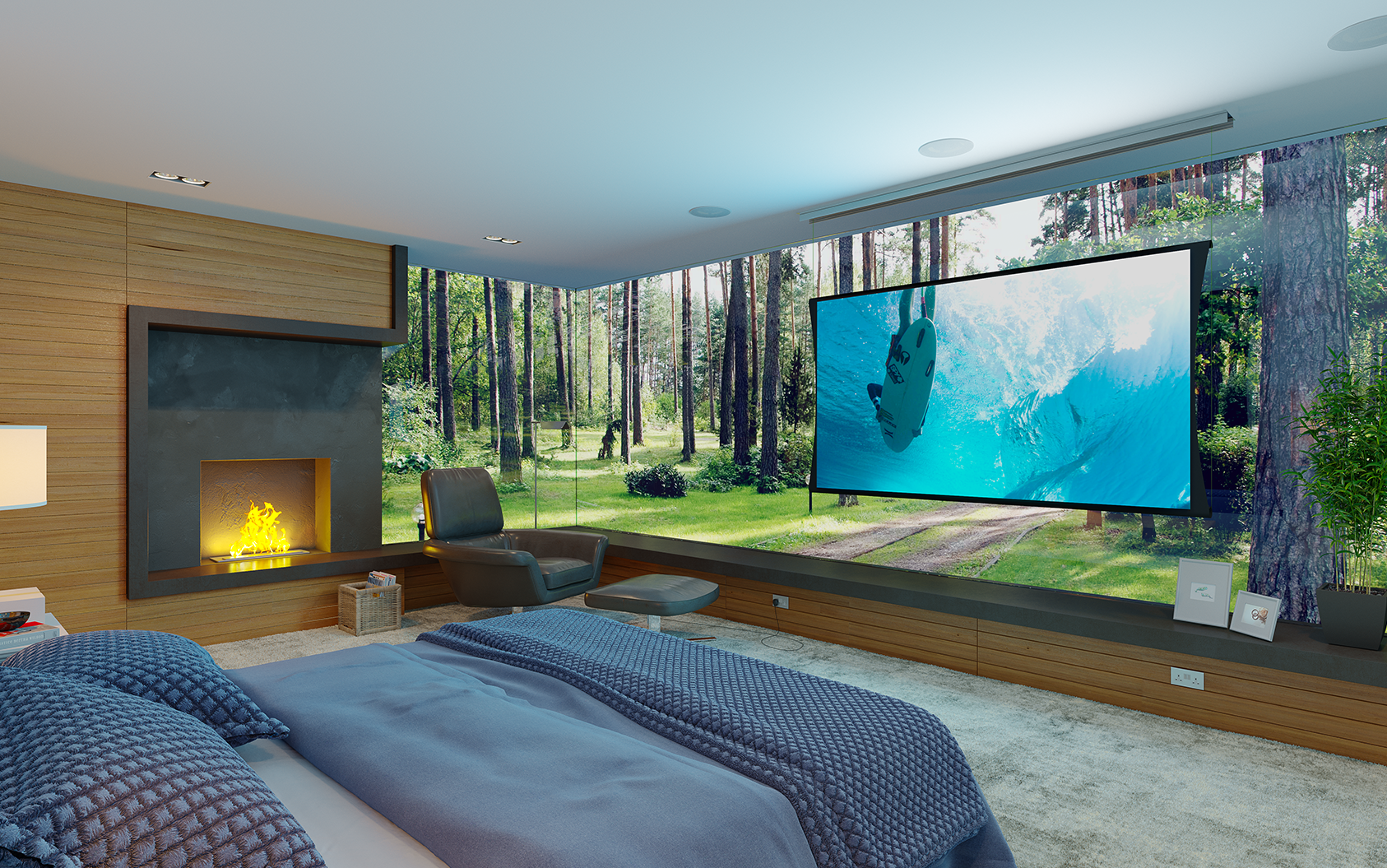
With two-piece projection systems, the TV can go where it should go, where it will compliment existing design and décor and provide an optimal entertainment experience, not where it has to go. This versatile technology can be seamlessly integrated into various parts of the home in such a way that it won’t be seen unless it is in use. For instance, drop a motorized screen like the new Black Diamond Motorized by Screen Innovations in front of a fireplace rather than above it, or in front of a picture window if those are the best locations. It’s there when wanted, gone when not, and by using motorization, the view is preserved while an exceptional, immersive home cinema experience that just isn’t possible with flat panel TVs is delivered. Don’t believe me? Try rolling up a TV to make it disappear, and you’ll end up with a pile of glass on the floor. Day-in, day-out, two-piece projection systems deliver greater versatility and flexibility than a flat panel TV ever will.
Isn’t two-piece projection cost-prohibitive when compared to a flat panel TV?
Nope. Not by a long shot. In fact, two-piece projection systems provide a significant advantage over large-format TVs in terms of price, feature set, aesthetics, and overall experience. It’s a common misperception that two-piece projection systems will end up costing more than a flat panel when both the projector and screen are factored into the equation, but the reality is that you can now get a much larger screen for far less money when you use two-piece projection systems. This is especially true when using screens over 80” or 90” in size.
Think of it this way. At 100” and above, images become life size. Meaning, movies, games, sports and videos are more immersive, more realistic, and far more enjoyable. At the end of the day, isn’t that what entertainment is supposed to be? The point is, two-piece projection systems enable you to experience TV in a way that was never possible before, in the comfort of your own home, in whatever room you wish, without breaking the bank.
You just can’t get the same experience with a flat panel TV as you can with a two-piece projection system. It’s that simple.
Here are some online tools you can use to determine space requirements, screen size options, and associated details that are paramount to creating quality two-piece projection systems.
The Seating Distance Wizard by SI is a neat tool that is provided at no cost. It’s a 2-step calculator that can be used to determine the distance you will need between your projector and screen.
http://www.screeninnovations.com/viewing-distance-calculator/
The screen calculator is another neat toll that’s also free of charge. It’s a 3-step wizard that when complete, provides you a .pdf detailing the screen and space dimensions as well as the model number and ordering information. What you’ll see when you use this tool is that two-piece projection can exist in virtually the same size space as a traditional TV:
http://www.screeninnovations.com/tools/screen-calculator/
So the bottom line is this: TVs are no longer the best option – nor the only option – for many residential installations. Consider two-piece projection systems for their versatility and value as well as the next-level entertainment experience they will provide. Then sit back, relax, and enjoy the show (in life-size dimensions).
Big Picture & Sound New Black Diamond Products 2013
When it comes to a big picture, there’s nothing like a projection system. That said, projectors are not practical in the average living room, since they require total darkness to achieve the best effect. Well, Screen Innovations may have something to say about that — or at least show.
The company had a variety of screens at last week’s CEDIA Expo in Indianapolis, Indiana, to show that projectors can work even in brighter environments. Let’s take a closer peek at the five new projection products that SI had on hand.
First up is the Black Diamond Motorized projection screen. Using the company’s award-winning Black Diamond ambient light rejection screen technology, this model can actually “disappear” when not in use — via one motor, four custom helixes, and a spool of slender aircraft cable. The screen also doesn’t require any type of masking or black drop material, making it any even more covert option. It also means that any projected images will look like they’re suspended in air. Other features include the promise of zero glare or reflection in any environment.
Another screen option is the new Black Diamond Zero Edge G2. According to SI, this is the world’s first and only multi-directional ambient light rejecting projection screen technology that actually looks like a flat-panel TV. It has a super-thin 10mm bezel, the Black Diamond screen technology, and a Zero Edge screen. Also, an optional LED Lighting Kit can go behind the screen for added effect. Available in either black .8 gain, dark gray 1.4 gain, or silver 2.7 gain screen materials, the Black Diamond Zero Edge G2 has a starting price of $3099.
SI also had a trio of screen materials on display, starting with one called Solar 4K White. This front projection screen material has a new emboss pattern, which boasts perfect color neutrality and zero sparkle. Design to deliver stellar active 3D, a wide viewing angle and sharp images overall, the Solar 4K is now shipping in 1-inch increments and custom aspect ratios for Reference series models or in standard sizes and standard aspect ratios for Performance series models, up to 12 feet by 330 inches.
The Lunar 4K .85 Gray is another front projection screen material with a new emboss pattern designed for perfect uniformity, color neutrality and enhanced contrast. This one boasts a particularly nice performance with ambient light and/or for those utilizing brighter projectors. This one is also shipping now in 1-inch increments and custom aspect ratios for the Reference Series screens or in standard sizes and standard aspect ratios for Performance edition projection screens, in sizes up to 205 inches.
Finally, there’s FlexGlass. This new rear-projection screen material can deliver the goods of rigid optical panels, but with the custom and curve capabilities from flexible screen materials. Boasting smooth images and an unmatched viewing angle, FlexGlass is designed to ditch hot spotting and has zero sparkle. Perfect for multiple-projector, edge-blending, and short throw projector applications, FlexGlass is available now in custom diagonal sizes and aspect ratios up to 7.5-by-131.23 feet…
Rave Publications Black Diamond Zero Edge G2
Screen Innovations (SI) demonstrated at CEDIA Expo 2012 a series of new screen materials and products.
The new Black Diamond Motorized uses SI’s Black Diamond ambient light rejection screen technology, which the company says reduces light scatter by over 75 percent, and is described by SI as an alternative to a flat panel display. Utilizing one motor, four custom helixes, and a spool of slender aircraft cable, Black Diamond Motorized lowers a thin wing containing the rolled Black Diamond screen downward from a recessed ceiling-mounted cassette. The cable-hung wing then stops, and from it, a small tube emerges and lowers itself down to an adjustable, pre-determined image height, leaving only the image space in sight. Because Black Diamond screens do not require masking or any black drop material whatsoever, there is no visible material above, below, or on either side of the screen surface, so it looks like the image is suspended in air.
The new Black Diamond Zero Edge G2 is a multi-directional ambient light rejecting projection screen technology that has the look and feel of a flat panel TV. It features a rigid panel and a 10-millimeter bezel. A new frame design provides better structural support and an integrated track system gives integrators the option to inlay an optional LED Lighting Kit behind the screen for added effect. Pricing starts at $3,099 MSRP and it’s available in either Black .8 gain, Dark Gray 1.4 gain, or Silver 2.7 gain screen materials.
SI also introduced three new screen materials. The new Solar 4K 1.3 projection screen material is a new front projection screen material that can do active 3D and offers a wide viewing angle. Now shipping, Solar 4K is available in 1” increments and custom aspect ratios for Reference series models or in standard sizes and standard aspect ratios for Performance series models, up to 12’x330”. The new Lunar 4K .85 projection screen material is a new front projection screen material that’s suited for applications with ambient light and/or those utilizing brighter projectors. Now shipping, Lunar 4K is available in 1” increments and custom aspect ratios for the Reference Series screens or in standard sizes and standard aspect ratios for Performance edition projection screens, in sizes up 205”. Finally, the FlexGlass rear-projection screen material is a new rear projection screen material that offers the benefits of rigid optical panels with the added benefit of custom and curve capabilities that can only be provided by flexible screen materials. It’s ideal for multiple-projector, edge-blending and short throw projector applications that are often needed in commercial installs. FlexGlass is available in custom diagonal sizes and aspect ratios up to 7.5’ x 131.23’.
Rave Publications Black Diamond Motorized
Screen Innovations (SI) demonstrated at CEDIA Expo 2012 a series of new screen materials and products.
The new Black Diamond Motorized uses SI’s Black Diamond ambient light rejection screen technology, which the company says reduces light scatter by over 75 percent, and is described by SI as an alternative to a flat panel display. Utilizing one motor, four custom helixes, and a spool of slender aircraft cable, Black Diamond Motorized lowers a thin wing containing the rolled Black Diamond screen downward from a recessed ceiling-mounted cassette. The cable-hung wing then stops, and from it, a small tube emerges and lowers itself down to an adjustable, pre-determined image height, leaving only the image space in sight. Because Black Diamond screens do not require masking or any black drop material whatsoever, there is no visible material above, below, or on either side of the screen surface, so it looks like the image is suspended in air.
The new Black Diamond Zero Edge G2 is a multi-directional ambient light rejecting projection screen technology that has the look and feel of a flat panel TV. It features a rigid panel and a 10-millimeter bezel. A new frame design provides better structural support and an integrated track system gives integrators the option to inlay an optional LED Lighting Kit behind the screen for added effect. Pricing starts at $3,099 MSRP and it’s available in either Black .8 gain, Dark Gray 1.4 gain, or Silver 2.7 gain screen materials.
SI also introduced three new screen materials. The new Solar 4K 1.3 projection screen material is a new front projection screen material that can do active 3D and offers a wide viewing angle. Now shipping, Solar 4K is available in 1” increments and custom aspect ratios for Reference series models or in standard sizes and standard aspect ratios for Performance series models, up to 12’x330”. The new Lunar 4K .85 projection screen material is a new front projection screen material that’s suited for applications with ambient light and/or those utilizing brighter projectors. Now shipping, Lunar 4K is available in 1” increments and custom aspect ratios for the Reference Series screens or in standard sizes and standard aspect ratios for Performance edition projection screens, in sizes up 205”. Finally, the FlexGlass rear-projection screen material is a new rear projection screen material that offers the benefits of rigid optical panels with the added benefit of custom and curve capabilities that can only be provided by flexible screen materials. It’s ideal for multiple-projector, edge-blending and short throw projector applications that are often needed in commercial installs. FlexGlass is available in custom diagonal sizes and aspect ratios up to 7.5’ x 131.23’.
To see videos we shot at CEDIA Expo 2012 from the Screen Innovations booth, click here.
Projection Screen.Net My Thoughts on Black Diamond Motorized
Screen Innovations recently announced their new Black Diamond motorized projection screen.
The black diamond fabrics are intended to be used in hgh ambient light situations.
With more and more people going for a projector in their living room, rather than in a dedicated theatre room, this type of fabric is more and more relevant these days.
The living room howver, is not really a place for a fixed frame screen, which used to be the common format for SI screens.
Now, there’s a retractable version that looks like it’s floating in the air, thanks to the cable system.
You can see the screen in this video
Screen Innovations Black Diamond Motorized
My thoughts
The use of the cable system isn’t new. It was pioneered by Grandview who made such a system for the professional AV market.
The idea of the motor placed in the tube isn’t new either; Procolor and Oray have done this for a long time in their range of large projection screens.
The combination of both technologies in a screen for residential installations is new though.
And that combination of different techonlogies is what I like most about this screen.
So let’s look at those in more detail:
The cable system
The cables make it look like the screen is floating in the air, which makes it look cool.
However, the main purpose of the cables is to have the screen drop to the right viewing height.
With regular screens, the viewing height is determined by the position of the screen’s housing and the amount of black drop that comes out of the screen.
The trouble with black drops is there is a relatively low maximum of almost 3 feet. Any length above that and your fabric will be in a V-shape in stead of perfectly flat.
Cables allow for the right viewing height and a perfectly falt screen – a nice combo
The motor
I don’t know which brand is used, but I am guessing it’s a Somfy with 32 rpm.
A fast motor is a greast choice, because many regular screens have only 17 rpm.
This means they take twice as long to unroll or roll in (given the same amount of fabric)
The fabric
More and more projection screens find their way into the living room where ambient light is not as easy to control.
That’s why a quality optical high contrast fabric works well, much better than a regular matt white or non-optical high contrast fabric.
It comes at a price though, so you’ll have to pay a premium for the increased performance.
The housing
The housing is a bit of a let-down.
Yes, it keeps it all light and yes, I know that once rolled in, it’ll be way up on the ceiling.
I would have preferred more of a boxed solution with 3 sides closed and just the bottom part open.
Conclusion
The combination of features is what makes this screen exciting to watch: when it is rolled out and when it’s used as a projection surface.
If you have the budget for it, you’ll enjoy watching it – and watching your guests amazement as it drops from the ceiling.
“I saw a stunning, bright and colorful image”
Screen Innovations has incorporated adjustable (and defeatable) back-lighting at the boarders of its zero-edge, fixed-frame projection screens. Just don’t call it Ambilight! Apart from this, however, I saw a stunning, bright, and colorful image (granted, the source was Speed Racer) on the 138-inch diagonal, 2.35:1, 1.4-gain Black Diamond screen, driven by a Sony VPL-VW1000 4K projector and a standard 2K Blu-ray disc. (read more)
Via Home Theater magazine and BestNoiseCancelingHeadphones.com
“Black Diamond Zero Edge ups the Ante”
Around this time last year, Jeff brought you word of Screen Innovations’ Black Diamond Zero Edge, an ambient-light-eating screen with an itty bitty bezel and a flat-screen aesthetic.
This year, SI is back with the second-generation Black Diamond Zero Edge II, which ups the ante with a new slender aluminum frame, a new adjustable flying cable system, 360-degree perimeter ambiance lighting with 256,000 colors, and a new aggressive pricing structure that, when paired with a good projector, makes it a better deal per inch than most flat panel TVs (read more)
Via Technology Tell
More from "News"
Sony Kicks Off 4K Marketing Campaign
New Product: Reference Quality Pure™ Zero Edge Projection Screens
“Black Diamond saved us money” – a photo-enhanced end user review
“For the video purist, the image on the Solar 4K material was hard to beat”
Black Diamond Motorized Demo Room
Videos Reveal Projection Video Trends & Technologies From Sony, JVC, Digital Projection & Epson
Black Diamond Motorized Projection Screen Now Shipping Worldwide
Playroom with Hidden Projection Screen Doubles as Home Theater
“Black Diamond is as clear as any TV on the market”
Screen Innovations NEW Mobile Site is Live!
“Best projection screens hands down!”
FlexGlass™ Rear-Projection Screen Material Now Shipping
Josh Petru Appointed to Commercial Technical Sales Representative
Info
Contacts
SI contact information
Where To Buy?
Dealer Locator
Locate SI dealer near you